A COLLABORATIVE native fish conservation project led by Western Murray Land Improvement Group (WMLIG) and Traditional Owners has relocated more than 100 fish and turtles from irrigation networks, and strengthened relationships with the community.
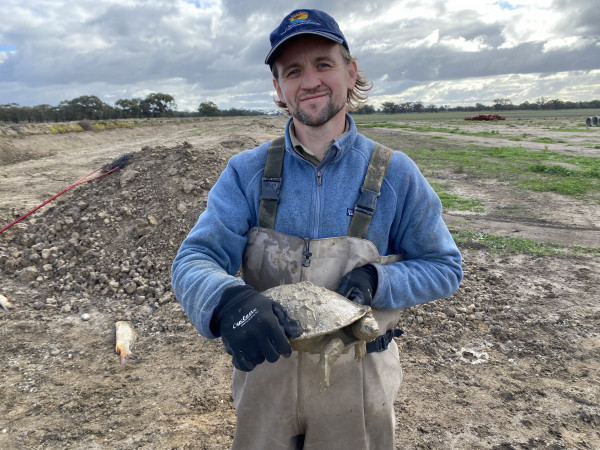
Of the 63 Murray cod, 33 golden perch, 13 silver perch and 13 turtles the combined Traditional Owners, WMLIG, and Murray Irrigation Limited (MIL) taskforce relocated to nearby rivers, most were of reproductive age.
The team also removed a significant number of invasive European carp, helping to protect the ecological balance of the region’s waterways.
The 2023 pilot of the project was designed after a Wamba Wamba and Wadi Wadi Elder identified an opportunity to relocate fish in the irrigation channels during the annual draining and dredging for maintenance works.
The pilot relocated 134 fish from more than 60 sites in nine days, including 78 Murray cod, eight golden perch, four silver perch, two trout cod, 39 black fish and two Murray crayfish.
Following this success, MIL and NSW Recreational Fishing Trust granted WLMIG $50,000 for a two-year fish salvage project for 2025 and 2026.
WMLIG project officer Luke Ward said the benefits extended beyond immediate conservation of wildlife, with the efforts also expected to galvanise the species as previously separated colonies interbreed and diversify the gene pool.
“By releasing over 100 reproductive age fish, we’re reintroducing genetic diversity where the population has become bottlenecked across the irrigation lines back into the main population, increasing biodiverse locations and resilience to pathogens,” he said.
“The Murray cod went from critically endangered to vulnerable, but their numbers are still well below pre-European settlement, and especially after the mass fish deaths in the rivers, a really low abundance of mature adults. So it’s really important for their conservation that we build some genetic resilience into those populations and ensure those breeding-age individuals can complete their life cycle in their natural habitat.
“In my role I am always looking for gaps between conservation recommendations and implementation, and the best way to learn about those gaps is people in the community telling us what they are seeing.
“There’s so much benefit to connecting with First Nations communities because there is that understanding in First Nations groups that ecology, biodiversity and ecological health are not separate from people or culture and have great significance.
“By collaborating with them and giving them the agency to foster, protect and restore those cultural and environmental values, we can improve the way we do things, and adopt that culture of custodianship in the ways we work and live.”
The combined taskforce is improving on the pilot methodology, incorporating oxidisation to the remaining water for the fish they are unable to reach for relocation.
“The goal is to keep it going every year, especially if we can continue working on different sites and learning as we go to be more effective in relocating as many fish and turtles as possible,” Mr Ward said.
“We set up fyke nets while the channels were being drained this year to make the most of the working group’s time, catching 99 per cent of the fish in that time instead of waiting around for them to be drained.
There were much deeper places we weren’t able to reach the fish, some of them up to 40-year-old Murray Cod, so to ensure they survived until the water was returned to the channels, we organised with MIL to purchase a semi-permanent aerator that we can move from site-to-site to oxygenate the water for the fish.
“Murray cod can live over 50 years, the oldest recorded estimated to be 75 to 80 years old, so with a breeding event each year after they are four to six years old and at less of a risk from predators the bigger they get, the big ones are really important for breeding. We relocated six individuals between 90cm and a metre long, so those are the bigger, older fish that will be great for the local rivers.
“It’s very rare to meet someone who doesn’t care about wildlife or nature, and I think by collaborating with organisations and the public, we are able to show we care and that we have the ability to make a positive impact.
“This cross-cultural and multi-organisational project showcases the power of collaboration between Traditional Owners, community groups, and local organisations to preserve and protect the unique biodiversity of the Riverina for generations to come.”
The community can reach out to Luke Ward at Western Murray Land Improvement Group to collaborate or raise concerns.