
HOPES of a plentiful agricultural season received a boost at the weekend, with areas receiving a month’s worth of rain in 48 hours.
Kerang’s Bureau of Meteorology gauge recorded 47.2 millimetres of rain between 9am Saturday and 9am yesterday – the equivalent of the January and February average rainfall combined.
The town’s gauge recorded 10.2 millimetres of rain between Saturday morning and Sunday morning, boosting January’s rainfall total to 28.4 millimetres.
A further 37 millimetres fell between 9am Sunday and 9am Monday – 13.3 millimetres more than February’s monthly average.
It is the biggest single rain event since 75.6 millimetres fell over three consecutive days in April two years ago.
The rain kept emergency service crews busy during the late afternoon, with Kerang Fire Brigade members called to a Nugget Street house to tend to a fallen power line. There was also a power pole fire at Koroop on Sunday night.
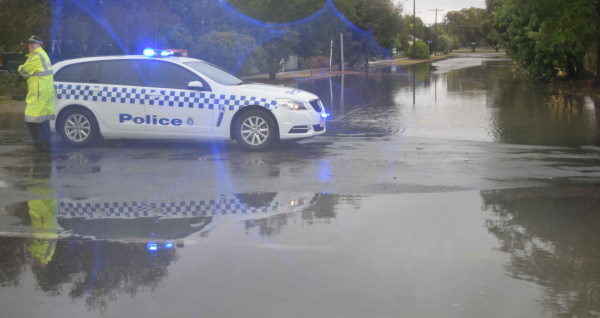
Police also closed the intersection of Mitchell Street at Kerang between Bendigo Road and Boundary Street after blocked stormwater drains created localised flooding.
Dianne Bowles’ dairy farm in Mead recorded 23 millimetres of rain.
“The rain is desperately needed with the high temporary irrigation water prices,” Mrs Bowles said.
“We have missed out on the last couple of rainfall events so very happy to finally win some.
“We had water ordered to irrigate and cancelled the order so have saved 10 to 12 megalitres of water thanks to the rain.”
Neighbouring Cohuna recorded up to 30 millimetres of rain, while 28 millimetres was recorded at Barham/ Koondrook and 24 millimetres at Murrabit in the north of the Shire of Gannawarra.
“We are a very small operation in our little town and also cut lucerne for hay, which takes up 10 acres,” Cohuna goats milk producer, Shayne Mostyn said.
“We will water that lucerne twice per cut. With water prices the way they are, each watering costs us just over $1000.
“This rain means we will only need to water in once, saving us such a figure.
“When we made our tree change, I couldn’t get my head around how people made money off the land. Give me a service contract on a photocopier and I could tell you how to make loads of money.
“Imagine how much money that same 30 millimetres of rain makes to an operation of a few hundred acres. It is amazing how much of a financial difference water makes to Aussie farmers.”
Quambatook received 40 millimetres of rain, while Tragowel was satisfied with 28 millimetres.
The rainfall ensured Kerang surpassed the January long-term mark for a second successive year, helped along by the weekend’s falls and an 11.0-millimetre recording on January 4.
The temperature failed to surpass 20 degrees, with the maximum of 18.1 degrees Kerang’s coldest January day in three years, when the temperature struggled to reach 18.5 degrees on January 13, 2013.
Despite the wet end to the month, maximum temperatures surpassed 40 degrees on three occasions last month – including a scorching 45.0 degrees on January 13.
The hot conditions ensured the average minimum temperature for January 2016 (17.5 degrees) was more than two degrees above the long-term figure of 15.1 degrees.
The temperature failed to drop below 20 degrees on six nights last month, with January 20’s minimum of 27.0 degrees the warmest night since December 20’s minimum of 30.0 degrees.