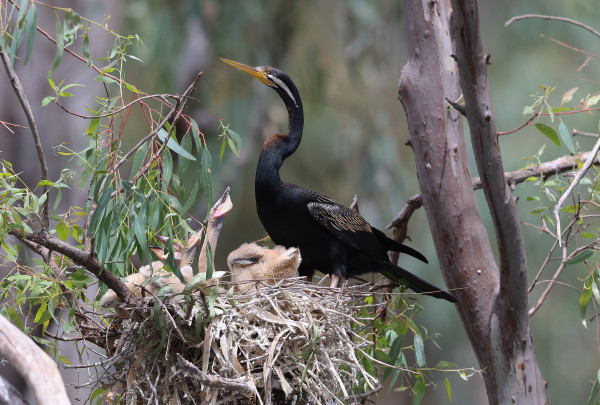
DID you know some juvenile waterbirds need to eat the equivalent of almost one hamburger a day when they leave the nest to survive to breeding age?
With the 2022 unregulated flows supporting significant breeding in Gunbower Forest and across the northern wetlands, that’s an order even the busiest Cohuna takeaway shop would struggle to fill.
Waterbird surveys over spring and summer conservatively recorded more than 1000 juvenile waterbirds in Gunbower Forest, most of which hatched within the forest, and a further 5000 adults across more than 30 species.
Across the region, more than 18,000 adults were counted, with actual numbers expected to be about 40,000. An additional 835 juveniles were recorded in the northern wetlands near Kerang.
However, despite multiple waterbird breeding events across the Murray-Darling Basin over the past decade, waterbird numbers have reduced by more than 70 per cent since the early 1980s.
According to the CSIRO, one of the possible reasons for this lack of population growth was high juvenile and sub adult mortality rate.
For the first two to three years of their life, young waterbirds need large amounts of food and are especially vulnerable to starvation, habitat loss, predation, and the impacts of climate change, all before they get to breeding age.
Adult waterbirds also need food to rebuild body condition after nesting and raising chicks over several months.
That’s why the Victorian Environmental Water Holder and North Central Catchment Management Authority (NCCMA) have planned an environmental flow in Gunbower Forest in winter and spring.
“We have an opportunity for the first time on the forest floodplain to build on a significant waterbird breeding event with a follow-up flow from our Hipwell Road channel, help these young birds survive to adulthood, and help their parents rebuild condition after raising their chicks,” NCCMA chief executive Brad Drust said.
“We need to lock in the gains of last year’s unregulated flows, help protect vulnerable waterbirds, and prepare the forest for the impacts of climate change.
“As the forest and the region dries out after last year’s high flows, it’s important all these waterbirds have somewhere they can go, with the right habitat variation and food resources. Gunbower Forest has all that.”
Mr Drust said before regulation, water flowed onto Gunbower Forest every one or two years, up to seven in every 10 years on average.
“That meant the forest ecosystems evolved with water in most years,” he said.
“But over the past 20 years, it had only had half that, which meant there was a major deficit.
“This represented less habitat and food resources for waterbirds. River red gums, and water-dependent plants have only been getting, at best, half of what they needed to just survive.
“Poorer habitat equals fewer waterbirds.
“We are working with all the local, state, and Federal Government agencies, as well as the community-based Enhancing Northern Waterways Advisory Group on the details of a proposed environmental flow starting this winter to help these birds survive.”
The community consultation, Mr Dust said, was: “really important for us, especially this year”.
“We know the community is still dealing with the outcome of the floods, and this group’s input, in that environment, is vital,” he said.
“We saw large-scale unregulated flows through these same forests in 2010-11, and we saw how quickly the condition of the trees and understorey vegetation deteriorated without follow-up water in the following years.
“We don’t want that to happen this time, and it doesn’t need to.
“With the Hipwell Road regulator and channel in place, we can get water to where it needs to be to make the most impact. That couldn’t happen 10 years ago.”
The proposed watering would target only 23 per cent of the forest, but would provide “a lot of hamburgers for hungry young waterbirds”.
“Even though we can only water 23 per cent of the forest, we have an opportunity to fill the gaps created by river regulation and climate change,” Mr Drust said.
“These Goldilocks flows aren’t large floods. Far from it.
“They aim to deliver the right amount of water at the right time of the year to mimic gentle, small to moderate sized natural floods.
“Under the proposal, forest wetlands and river red gum areas will be watered, attracting waterbirds, and allowing plants to flourish.
“The forest will be a beautiful place to visit, especially during spring and early summer when the trees and wetlands are at their best.
Popular camping and fishing areas along the Gunbower Creek and the Murray River would still be accessible, but alternative routes may be required.
More details about the flow will be known closer to the proposed start in June.