IF there is one thing that local irrigators, environmentalists and lobby groups all agree on, it is that the Murray-Darling Basin Plan is being treated as a “political football”.
Late last week, a Senate committee released its findings and recommendations for the proposed Water Amendment Bill, which aims to deliver the Basin Plan in full.
The committee received more than 120 written submissions and heard from more than 100 witnesses, spanning 45 organisations representing government at all levels, industry including irrigator and agriculture interests, environmental groups, First Nations representatives, and scientists.
Among 15 recommendations, the committee was in favour of voluntary water buybacks, while suggesting that unviable SDLAM projects be scrapped and no new projects added.
It overall believed the Water Amendment Bill should be passed with amendments.
“The committee recognises the concerns of irrigators, farmers and processors, while also recognising that the future of those industries is reliant on a healthy river,” the report said.
“Nevertheless, there is broad support for the Basin Plan’s overall trajectory, and its objectives to bring the basin back to a healthier and more sustainable level, while continuing to support agricultural industries and basin communities for the benefit of Australia as a whole.”
VFF water council chair and Murrabit farmer Andrew Leahy believed rural communities were being treated as “political pawns”, and that they deserved more from decision-makers.
“It’s time our leaders stopped playing political games and focused on delivering solid policy that makes a real difference to people’s lives,” he said.
“In the past we could rely on the Murray-Darling Basin Authority to provide apolitical advice, but not anymore – sadly, they are now just a politicised arm of the Commonwealth bureaucracy.
“It’s time for a return to the days where scientists and bureaucracy provide apolitical analysis.
“It is only then that our ministers can make informed decisions that are in the public’s interest.”
Gannawarra Shire Mayor Ross Stanton also had concerns with the committee’s findings, particularly its support of buybacks.
“Our communities are still feeling the effects of the last buyback period, which reduced the amount of water available for agricultural use and had a detrimental effect on irrigators, especially in the dairy sector,” Cr Stanton said.
“Any resumption of buybacks will have flow on impacts to most people in the community, at a time when we are experiencing new investments in agriculture and positive population growth.”
But environmentalist and former Koraleigh irrigation famer Greg Ogle told The Guardian he was supportive of the Basin Plan, having seen firsthand the devastation caused to the river system before the plan.
“It’s not about people sitting around a table wanting to make money, it’s about saving the river,” Mr Ogle said.
“It has sort of all been hijacked by corporate companies leading our community into believing it’s all bad – we have got to realise that there is a lot of good in this Basin Plan.”
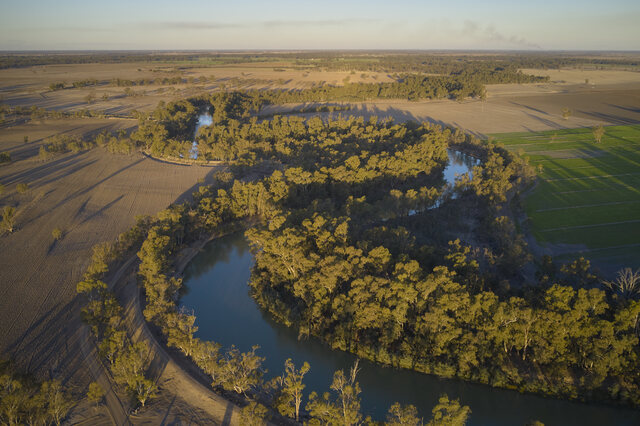
Mr Ogle recalled when the Poon Boon Lakes, a series of interconnected floodplain lakes between the Murray and the Wakool Rivers, went dry between 2001 and 2011.
“It was just so socially devastating,” he said.
“Kids in this town didn’t even believe we had lakes here, they were just dry dustbowls.
“It was a really visual and physical effect that the bad health of the river had here – it wasn’t a bottom line in some company, this was real.
“The real life is sometimes being forgotten, it shouldn’t be all about the economics.”
He believed it was that drought event, combined with the over-allocation of water licences, that triggered the creation of the basin plan to try and save the river system.
“(Water) is a natural resource, and in my view, it should never have been privatised – it should have been a public resource that was available for all people in a sustainable matter,” Mr Ogle said.
“The simple fact is that we have over-allocated the water.
“It’s like the health in your body. You can’t keep treating it bad and expect it to get better – at some stage, to survive, you have to bite the bullet and try and go back to a sustainable level of health.”